The Kind of Society Built by Bystanders
16 unintended but inescapable consequences for a society caught in the riptide of complicity

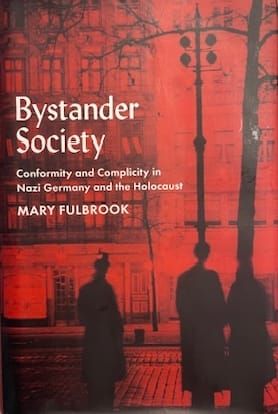
Only about 10% of the population — 15% of the electorate — ever officially joined Germany’s Nazi party. This little statistic undergirds the research in Bystander Society: Conformity and Complicity in Nazi Germany and the Holocaust (Oxford University Press) by Mary Fulbrook, professor of German History at University College London. The Nazis required bystanders to enable the Third Reich. Hitler and his party could not have accomplished their goals on their own.
“Putting discriminatory categories into practice, and effectively enforcing them in all spheres of life, requires also the participation of individuals across society. . . . Crucially, this might be less a matter of learning to hate than of learning to comply, to conform” (pages 377–378). The Holocaust never would have happened without bystanders.
Bystanders assumed they could insulate themselves in what I would call a mythical cocoon of moral neutrality. In reality, “People in the muddled middle learned how to perform Nazism in everyday life and gradually became accustomed to it, seeing also the potential benefits of conformity. As others fell into line, it became less and less easy to risk standing out. In a snowball effect, increasing numbers behaved according to the new norms . . . people made compromises . . . and then tried to justify their choices. The outward conformity of the muddled middle—those who were neither enthusiastic supporters nor immediate targets of the regime—ultimately served to further the Nazi project” (88).
Professor Fulbrook follows the story of a number of conflicted individuals, such as Bruno, who worked on the propaganda displayed at the 1936 Berlin Summer Olympics. He raised criticisms of Nazism privately, but publicly toed the line. Privatizing his denunciation of the Reich only allowed the public vacuum to be filled by the Reich. “No doubt in the private sphere, among friends, he helped to sustain the morale of people excluded from other circles. But in his professional capacity, [Bruno] contributed to the ideological construction of the Nazi national community.”
He was self-aware enough to write in 1939: “This wishful thinking that by sticking to one’s job and by compromising one could moderate the politics of the Nazis was a mistake made by quite a number of sincere and well-meaning people.” Dr. Fulbrook comments: “He and Germans like him effectively furthered the Nazi cause, whether or not they approved of it. . . . principled opposition to racism in the private sphere . . . was bought at the price of conforming in public and in professional work. . . . life within a racist regime could compromise even those who were consciously trying to withstand its pressures—and yet allow them to continue feeling they were in some way against it” (116–117).
Fulbrook calculates generously that 80,000 Germans lifted a hand to help a Jew during the Reich. Out of 80 million Germans, that means “99.9 percent of Germans did not extend significant help to those who were persecuted” (446). Yad Vashem counts 28,707 ‘Righteous’ non-Jews from all nations; less than 700 of whom were German.
What is a bystander society?
Wegschauer is the German term underlying bystander. It refers to a person or society “looking away from” or refusing to face what is happening. The author defines bystanding as “pretending not to have seen, not to have registered what is going on, in order to avoid becoming uncomfortable or involved. It is simply easier to have ‘not known,’ thereby not having to face any questions of guilt about an outcome that might potentially have been averted” (3).
She acknowledges that “Bystanders in places where violence in word or deed is legitimated or encouraged by those in positions of power and authority are in a difficult situation. It is far easier to turn away, fail to react, pretend not to have witnessed a difficult situation, or even to find ways of agreeing with the dominant view” (24). It is indeed an unenviable circumstance that would test the mettle of the most courageous heart.
The temptation to retreat into an “inner emigration” of self-exculpation is multiplied when one’s entire society appears to be justifying injustice. “This is a society in which a majority of people are indifferent to the suffering of others, or feel powerless to intervene on their behalf, or claim ignorance of their fates” (24). By sharing a treasure trove of German diaries and writings from the 1930s and ’40s, Dr. Fulbrook shows readers what kind of society is rendered by bystanders.
1. A society that empowers impunity
Before the general populace had to face the temptation of bystanding, conservative politicians had grasped the forbidden fruit of power-at-all-costs. They were so blinded by their hatred of communists and liberals that they lacked the perspicacity to recognize the fury they were about to unleash by conferring their chancellorship upon Hitler in 1933: “The crucial final step to Hitler’s appointment was the misjudged gamble of conservative elites that they could benefit from his popular support while containing him within a mixed cabinet; some form of populist nationalism seemed an acceptable compromise” (377).
“At this very early stage of the Nazi regime, things might have developed differently if significant institutions and people in positions of power and influence had been more willing and able to speak up and stand out” (97).
Hitler and the rise of his nationalist party was not inevitable. “Germans in high places were in a position to have stopped Hitler in his tracks; but most members of the German elites—government ministries, civil servants, the military, lawyers, medical professionals, sections of industry, the churches, universities—simply fell into line, variously conforming, benefiting from, and faithfully carrying out the exclusionary and ever more radical policies of the Nazi regime” (396). As Timothy Snyder famously warns, “Do not obey in advance.”
2. A society that swallows pretexts
State terror merely reflects the narcissism of those pulling its levers. Just as a narcissist shrewdly plays the victim to justify their predation, the terrorizing state astutely maintains a veneer of legitimacy. Thus, “violence was portrayed as a supposedly proportionate ‘response’ warranted by some prior ‘provocation’, a form in effect of ‘defensive retaliation’ ” (205).
Staging false-flag operations are one tool in a government’s arsenal to gain bystander acquiescence and stoke enthusiasts’ support. Under certain circumstances, rhetorical rationalization is all that’s needed to gain people’s cooperation. Having sufficiently persuaded its people that the nation is under threat, the state has a green light to unleash its might.
The false-flag Reichstag Fire, conducted one month into Hitler’s chancellorship in 1933, was his pretext to declare a state of emergency. It enabled the Nazis to arrest political opponents and to pressure coalition parties to capitulate. By the middle of the year, only one party was declared legal — thereafter making elections a sham. By the end of the year, 200,000 persons (.3% of the total population) had been arrested as political prisoners.
Perhaps the second most famous false-flag was the Gliwice Radio Tower Attack in 1939 which opened the door for Hitler to invade Poland. The day after the staging, Wolfhilde, a teenager, celebrated in her diary how the Führer “called his people to arms, to protect the German lands and Heimat [homeland] and to defend itself against its enemies” and how she and her friends were “proud and confident about the times that were coming” (246).
3. A society caught in a riptide
One non-Jewish woman named Verena found that only fish with the backbone of a countercultural worldview could swim against the tide: “like those with religious convictions, or Freemasons, and Quakers” whereas most fish “accepted the injustices that were taking place simply as facts that are regrettable but cannot be changed” (105).
The author credits that “some Germans resisted complete compliance with Nazi norms, but they were not prepared to flout them in any way that might be visible to others. This was going for risk-free noncompliance, rather than any real form of resistance” (159).
Alfred, a lawyer (whose parents converted from Judaism to Christianity c.1892, who was baptized and raised Christian, who earned the Iron Cross in World War I, and who was married to a Christian, and yet was counted as Jewish) described the German sentiment of 1939 as: “dull apathy of the soul; one gradually got used to the fact that the Jews were being persecuted and that they had to suffer.” Fulbrook comments, “This apathy was in part a self-protective reaction: unable to change things, it was easier to accept the way things were, numbing oneself to any sense of frustration or outrage by simply assuming this was now the way things had to be. Rationalizations could justify passivity, if need be; this was what had to happen, in service of a greater cause, the future of the German Volk. Indifference towards the fate of Jews, or attempted legitimation in terms of a wider collective good, could assist in assuaging any possible feelings of personal discomfort” (217).
4. A society that abandons the downtrodden
The experience of Jews was that “most ‘Aryan’ Germans dropped friendships with Jews before they had to” (113). Copping out by non-Jews paved the path guaranteeing ostracism for the downtrodden and society’s indifference to it. “As ‘Aryan’ Germans . . . dropped social contacts with Jews and snubbed any they met on the street, so they increasingly lost touch with the lives of the outcast. The growing social and spatial difference made it easier, too, no longer to care about those with whom they were no longer in contact: indifference grew more easily if one simply did not know, or chose to ignore, the fates of the excluded” (117).
Private expressions of outrage amounted to empty solicitude. Bystanders’ “passive silence or tacit approval” had the same effect and sounded the same in the ears of both prey and predator (257).
After having survived the Gurs internment camp where her husband had died, Betty reflected, shortly after the war, on her experiences: She “was particularly bitter about the total failure of her former neighbors to intervene on their behalf or even to show any sympathy or support. Indeed, she recalled, the worst Nazis among the ‘Aryans’ had been not the Hitler Youth, but members of the women’s organizations, people whom she knew by name; and ‘today’, she added, ‘they all claim they were not there’. None of them ‘showed any shame or regret’ for their abominable actions” (257–258).
5. A society with no one to talk to
Because the risks of being accused of treason against the Reich were so high — not only were workers and neighbors incentivized to betray one another, but even children were groomed to denounce their own parents — people rapidly evolved into living lives of duplicity. “It was impossible to tell who was dissembling and who was not. . . . People who do not know what others in a group actually think often decide that it is safer to go along with what appear to be the dominant norms in order not to stand out” (145).
6. A society where sympathy is backhanded
Platitudes such as, “If only all Jews were like him, then everything would be alright,” were in fact, Fulbrook points out, a “back-handed compliment, suggesting an individual was an exception while reinforcing the prejudiced stereotype, that would be heard repeatedly across Germany as people extended sympathy to individuals even while excluding them” (52). Cheap assuagements only highlighted the speaker’s racism and mitigated nothing for the person still being downtrodden.
Martin, a Jewish physician, recorded the complaints of non-Jewish patients about “radical” Nazis and how it was “terrible that those who are innocent now also have to suffer for the crimes of others.” These same patients, however, nullified their pity with “something had to be done about the Jews” (71).
Joseph, a young Catholic, expressed his only reservation as a Nazi: “I do feel real sympathy for those few who, because of the really guilty, were often affected particularly harshly by the necessary measures taken.” It was a frequently parroted talking point to express pity for the one “good Jew” suffering because of the rest (142–143).
The insidious racism of such attitudes has been little recognized. Each generation flatters itself as more evolved than the previous. We Americans fancy ourselves on the one hand with saying “We’ve come a long way since 19??” . . . and yet we chant “Make America Great Again!” There hasn’t been a more ironic moment in American history since the signing of the document that declared “all men are created equal”.
7. A society necessitating oppression
Non posse non peccare (not possible not to sin) is the Augustinian phrase describing humanity’s predilection to sin. It could be said about a people driven to dominate their nation: Non posse non opprimere — that it is not possible not to oppress.
Anti-Semitism and bystanding were taking place long before Hitler rose to power. One non-lethal but telling example happened in 1918. A senior physician was denied an elected office because he was Jewish. He was publicly told “we want to emphasize our nationality, just like everyone else is doing, the Czechs, the Hungarians, the Serbs, the Poles, etc. We believe therefore that the leadership . . . must be in purely German hands” (40). The implications being at best, one could not be counted both Jewish and ‘German’. At worst, the desire for a dominant-ethnic nation demands discrimination against minority people-groups as defined by the majority. A witness recorded that “none dared stand up for him in public . . . they were all essentially good-natured but lacking in civil courage” (41).
By 1935, with new laws codifying systemic discrimination, “It was not merely okay to discriminate: it was legally no longer permissible not to discriminate” (154).
8. A society running on emoluments
Mandating oppression of the minority class sought to advance the dominant class. “With the ‘aryanization’ of property and the growth of professional opportunities, as Jewish educationalists, medical practitioners, and business people were forced out of their former positions,” bystanders were well positioned to profit (154–155).
The businesses, homes, jobs, and personal property wrested from Jews, became the largesse that helped mollify bystanders. The state thus stimulated bystanders to remain standing by.
The advancements achieved for Hitler’s base also served an important function: It “prevailed over discussion of the darker sides of Nazism. Even if they feared that economic recovery was unlikely to last, many people felt there was at last a certain stability. And few had cause to note the disappearance of Jews from their neighborhoods and therefore their consciousness” (162).
9. A society unable to stomach dissent
For insecure leaders, free speech — let alone dissent — must be not only monitored but snuffed out. One reluctant Nazi confessed to a Jewish teacher in Breslau (now Wrocław, Poland) that “even Aryans had to be very careful with every word, if they did not want to suffer highly disagreeable consequences” (213).
Eugen, a Jewish businessman, reported that “twelve workers in a factory who had organized a demonstration of solidarity with the Jews had been shot dead on the spot, and four hundred others had been taken to a concentration camp” (217).
10. An inhumane society
Non-Jewish Verena wrote that her brother was the model of a modern Nazi soldier: “carrying out orders, without taking a view on them. Obedient, uncritical, brash, the ideal educational product of the new regime.” Those were not compliments. She and her Jewish husband had to flee. Their “Heimat (homeland) was lost . . . Germany had fallen silent” (244–245).
Fulbrook notes, “Among soldiers, violence against civilians was not only ideologically inculcated but also exercised in practice. There was an official policy of ‘reprisals’ against whole communities, including civilians.” Recruits were brainwashed to suspect their own fellow citizens as potential enemies, rendering preemptive strikes necessary. Schießlust described the soldiers’ “desire to shoot” (249).
An altruistic ethic of self-sacrifice is not enough. Both a loving God and an evil Enemy issue the call to spend one’s self with valor. The difference is whether one’s cause reflects holiness (beauty, goodness, and truth) or a corruption of it.
Jihad inspired joy. Walter, a 36-year-old father of two, wrote a series of letters to his wife from the frontlines in October 1941: “I am as happy as before that I am able to experience this battle of fate of our Volk and that I am able to participate in the struggle . . . already 27,000 Jews have been bumped off [in Belorussia] . . . and in Kiev 24,000!” (325). Six months later his letter conveyed: “Everyone here feels himself solely ‘German’ and to be German today means only to be ‘Nazi’. There is nothing else” (326). Clearly Walter was a poster-soldier for the Reich: not only an ethnic nationalist, not only a Nazi, but someone who embraced the intended fusion of these identities into an eternal singularity.
Günter, a soldier stationed in Brittany in 1943, diarized about re-reading Mein Kampf. He was “again being drawn under its spell” which compelled people to follow the Führer’s vision and “thus participate in his greatness”. Günter prayed for Hitler’s “strength and health to achieve his great goal”. He expressed his enthusiasm: “grateful to fate, that I may be allowed to live in this hardest of all times. Never again will I think of myself! I will renounce my own egoistic-personal happiness. In future I will find happiness only in the knowledge of joyfully accomplished duty!” (337–338).
11. A society where lambs are cowed by bullies
Two years before he would eventually hide a Jew, Friedrich, a Christian diarist, recorded his inner turmoil over how history would judge his generation: “You judge us and find us wanting, and we, here, suffer in loneliness and dread. You point at us, and our lack of resistance, and we know that the resistants [sic] have died unknown in filthy bunkers, and that the blood of martyrs has been spilled to no purpose” (332).
Fulbrook remarks, “Remaining silent meant in effect condoning brutality and murder, even if this strategy was a form of ‘muddling through’ in existentially threatening times” (339).
12. A society that infects
Oppressive discrimination, while it is homegrown in every nation, can be fanned into flame by the sickness in other lands. American racism inspired Nazis as they designed their legal apparatus. History shows that “Nazi lawyers and bureaucrats had taken an interest in American laws restricting citizenship rights . . . the racial distinctions embodied in the Nuremberg Laws [1935] were marginally less harsh than those in the United States enshrining notions of white supremacy . . . But Nazi state-imposed racism was subsequently implemented with more central direction and ultimately far more deadly effect” (153).
As Nazi forces entered the Baltics in 1941, Goebbels’s propaganda machine knew how to push the right buttons. There, the Nazis appealed to Lithuanians and Latvians who had fought Bolshevik communists. The Baltic population was susceptible to categorizing all Jews as mere Bolsheviks.
In Lithuania, bystanders failed to interfere with Nazi massacres of Jews. “Whatever their individual feelings, none of the observers made any attempt to intervene on behalf of the victims of this brutal violence. They stayed on the sidelines, some cheering and applauding, others shocked into passivity and disbelief, as innocent Jewish civilians were battered to death before their eyes” (274). Lithuanians were paid to round up Jews, potential threats, and members of the intelligentsia. “They were not merely willing helpers of the Germans but seemed eager to seize the opportunity to vent their own hatred towards Jewish fellow residents, to the shock and horror of Jews who had known them for years” (277–278).
Latvians, likewise, “now turned on their Jewish former colleagues, friends, and neighbors . . . whom they blamed for the period of communist rule” (280). Bernhard, a Jewish Latvian physician recalled, “the murderers raged with particular fury in rural areas and in the small Latvian towns where everyone knew everyone else and everyone knew where the neighboring Jewish families lived. . . . As the corpses of our Jewish fellow citizens, friends and relatives piled up around us, as the blood of innocent people was spilled in streams, we looked for help to our Latvian fellow citizens, friends, and acquaintances, convinced that surely here or there a hand would be lifted to help us, surely a mouth would open to speak to us a word of comfort—but in vain. A bloody frenzy had overcome the country. . . . Tens of thousands and hundreds of thousands were witnesses of the most horrible crime in human history and remained silent about it. Nowhere was the faintest voice raised to protest the universal bloodshed” (281).
13. A society clothed in fig leaves
The day after helping to oversee the shooting of 300 children, women, and men, a German soldier wrote to his Catholic wife: “Yesterday I became convinced that there is no God. If there were, He would not allow such things to happen” (292). How easy to exonerate oneself by condemning God.
Chapter 10, titled “Inner Emigration and the Fiction of Ignorance”, notes that “from April 1945 at the latest, in public Germans widely claimed ‘ignorance’, implying that ‘knowing’ would have affected how they would have acted or why they failed to act” (310). Fulbrook elucidates that the epistemological question “is arguably the wrong question to be asking. The right question, or questions, are, What did they make of what they knew? How did those directly involved in atrocities try to justify their actions? How did others who heard about them interpret what they knew?” (311).
Pleading obliviousness is an obvious obfuscation of obligation. The ethical questions remain. “Many Germans would, after the war, claim they had been ‘always against it’ (immer dagegen)” (341).
14. A society disappearing the honorable
One insurance agent did speak up in the wake of the destruction of a synagogue in Berlin. He was described as “loudly expressing his outrage that the state was making insurance companies pay up to the state for the damage but not to the victims, the Jews whose property had been destroyed; in this man's view, the state consisted of 'robbers, murderous arsonists, bandits!' When warned that he should keep his voice down, he said that at least if he ended up in a concentration camp, he would know he would be in there together with decent people” (218).
In this regard, the prey retain their dignity. Else, a Christian whose father and husband were non-practicing Jews, diarized, “it is so much easier to be among those who are suffering injustice than those who are perpetrating injustice. . . . [Those suffering] go towards an uncertain and heavy fate with heads held high . . . [their] self-respect and sense of worth as human beings” undamaged (313).
15. A society of kleine Männer (little men)
Some non-Jews who were eager for Nazism to fade away, attempted to justify their current position to their Jewish friends: “You just can’t understand it . . . the only way forwards for us is to join the Party, join the Movement, only in that way can we prepare for whatever will eventually replace the current regime” (118).
A doctor who joined the Nazi party, Horst, reasoned shortly after the war: “there would have been nothing I could do. I would have been a little man in an enormous machine. I could not have taken the risk to speak up. My family comes first’ (364).
Günther, a Nazi district judge claimed: “I’m not defending what the Nazis did, I just want you to understand that a little man like myself had no opportunity to disapprove.” He then condemns himself with staggering naïveté or foolish logic: “I felt that these excesses were temporary wartime affairs. Had we won, I’m sure they would have ceased immediately” (365).
16. A society slouching toward culpable complicity
Fulbrook conludes that “millions of people had learned to acquiesce” (374). Her diagnosis is that “indifference, ignorance, and impotence are socially produced: we can learn to not care, to turn away and ignore the fates of others, to feel powerless in face of overwhelming force or impossible constraints; and we can acquire and internalize the discourses that make us feel alright about what we are doing or failing to do . . . bystanding is, over time, neither a neutral nor an ‘innocent’ position” (398).
Bystander Society demonstrates that “remaining passively on the sidelines will inevitably affect the course of events. And, over the longer term, people will themselves be changed by adapting to living within a sustained system of violence. They will use the vocabulary and adopt the habits and relations that the system demands, and in this way actively help to perpetuate the injustices to which they were initially merely witnesses” (392). The cost of being a bystander is more than bargained for.
Bystanders made resistance more difficult: “widespread outward conformity—for whatever range of reasons—led to the perceived fiction of unity and consensus, making it even harder for wavering souls to risk standing out from the crowd or to challenge dominant views. There was a significant process in operation here: even constrained conformity had a wider impact on what others felt it possible to do or say, and what they dare not even attempt. So, in effect, even constrained conformity could lead ultimately to a form of complicity, assisting the slide towards ever more radical violence against those who had been ousted from the national community” (395). Unintentionally, bystanders hamstrung opposition and enabled “mass extermination without outcry” (397).
If you faint in the day of adversity, your strength is small.
Rescue those who are being taken away to death;
hold back those who are stumbling to the slaughter.
If you say, “Behold, we did not know this,”
does not he who weighs the heart perceive it?
Does not he who keeps watch over your soul know it,
and will he not repay man according to his work?
—Proverbs 24.10–12 (ESV)