Math & Boaz in Revelation 7
A vision of mathematical hopefulness (Revelation 7) interrupts the disclosure of death & destruction described as the Lamb unseals 6 of the 7 prophecies about the end of history (Revelation 6).


Click here to read Revelation 7.
Outline
- 144k + Countless Multitude
- Arithmetic
- Turning up the contrast on the 6th seal
- Unintentional prophetic action
- 9 Blessings
144k + Countless Multitude
John sees two groups of saved humans: First: the 144,000. Second: the countless multitude.
First he meets the Jewish saints who are represented by 144,000 (Revelation 7.4–8). I take the 144,000 to mean God will make good on his promise to save the true offspring of Abraham & Sarah, the remnant of Israel. As Paul wrote:
“I ask, then, has God rejected his people? By no means! For I myself am an Israelite, a descendant of Abraham, a member of the tribe of Benjamin.”
—Romans 11.1
In the Old Testament, every census had unequal tallies for the various tribes. But here the Jewish remnant is represented by equal headcounts. I take the 12,000 results for each tribe to mean that when we get to the other side of eternity we stand on equal footing in terms of our justification.
When John meets the crowd or multitude (Revelation 7.9), he describes them both as in addition to the 144,000 and more than a countable number. The greater number of this crowd makes sense since the 144,000 are reportedly the sons of Israel whereas the crowd is from every other people group.
Arithmetic
When my family lived in the UK, our friends there enjoyed poking fun at our American English because, for example, instead of talking about sport we talked about sports, and instead of saying maths, we would say math. Somehow the appropriateness of singular and plural forms of certain words evolved differently across the Atlantic.
In Revelation, John’s mathematical word to describe of the huge crowd is that no one could arithmeō (count, number, measure, calculate) it. This word occurs throughout God’s Word, but let me mention just two in the first book of the Bible:
An obvious parallel is when Yahweh challenges the husband of an infertile wife with an irrational revelation:
“Look toward heaven, and number the stars, if you are able to number them. . . . So shall your offspring be.”
—Genesis 15.5
Immanent things, such as a baby, can be attributed to immanent agents, such as fertile parents. But transcendent things, such as a star out of reach and hundreds of thousands of these stars, cannot be attributed to immanent agents; they must be credited to transcendent ones, something(s) that is outside of us and beyond us. The inability of the unaided human eye to even calculate the census of the celestial lights is reflective of a reality that transcends our human capacity to fully understand it, let alone to having created it and ultimately control it. These transcendent qualities of nature are a signpost pointing to how the creator of the Universe likewise surpasses us.
These are the kind of thoughts going through Abraham's mind when he looks up into the unpolluted sky on that ancient night recorded in Genesis 15. We know this because the very next line says Abraham
"trusted in Yahweh"
—Genesis 15.6
Abraham had lost count, but he did not miss the sign pointing to the one who keeps count.
A less obvious but fascinating parallel is that based on a dream: In the 7 years of harvest preparing for the 7 years of famine:
“Joseph stored up grain in great abundance, like the sand of the sea, until he ceased to measure it, for it could not be measured.”
—Genesis 41.49
God had given Joseph a supernatural revelation that after the next 7 years there will come 7 years of devastation and death. And so Joseph prepared Egypt by storing good grain for each town in order to save as many lives as possible throughout its empire. The quantity of that food was incalculable.
Joseph, the supernatural strategist of Egypt's bureaucracy, lost count. But he did not lose count of saving the lives of Abraham and Sarah's grandson Jacob, Abraham and Sarah's great-grandsons (Joseph's brothers), and Abraham and Sarah's great-great-grandchildren, not to mention the greater number of Egyptians and sojourners from North Africa and the Eastern Mediterranean world.
Turning up the contrast on the 6th seal
Now, in the table below I want to show you how God’s revelation to John sets up a contrast between the Godly crowd in Revelation 7 versus the worldly people at the end of the previous chapter in Revelation 6.
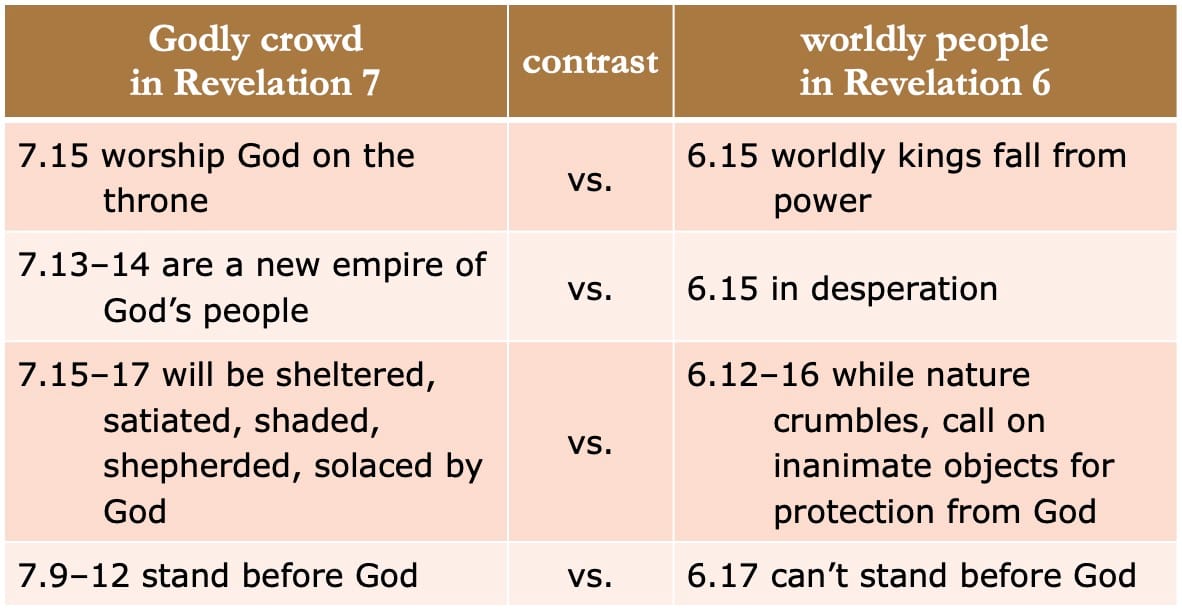
Circumstances may appear dire and dreadful. But those who trust in the Trustworthy One will have the reward of standing in his fuller presence, being his new people, and sheltering under his self-sacrificial care. God can extend such blessings because he remains on his throne.
Unintentional prophetic action
The incredible vision depicted in the closing verses of Revelation chapter 7 is the story of Ruth and Boaz. Ruth and Boaz didn't know it, but their simple acts of endurance and righteousness echo down through the ages, being reflected even in the vision to John in Revelation 7. Such is the life of Godly faithfulness. Here I'll compare the relevant elements from the book of Ruth with a recap of Revelation 7.14–17:
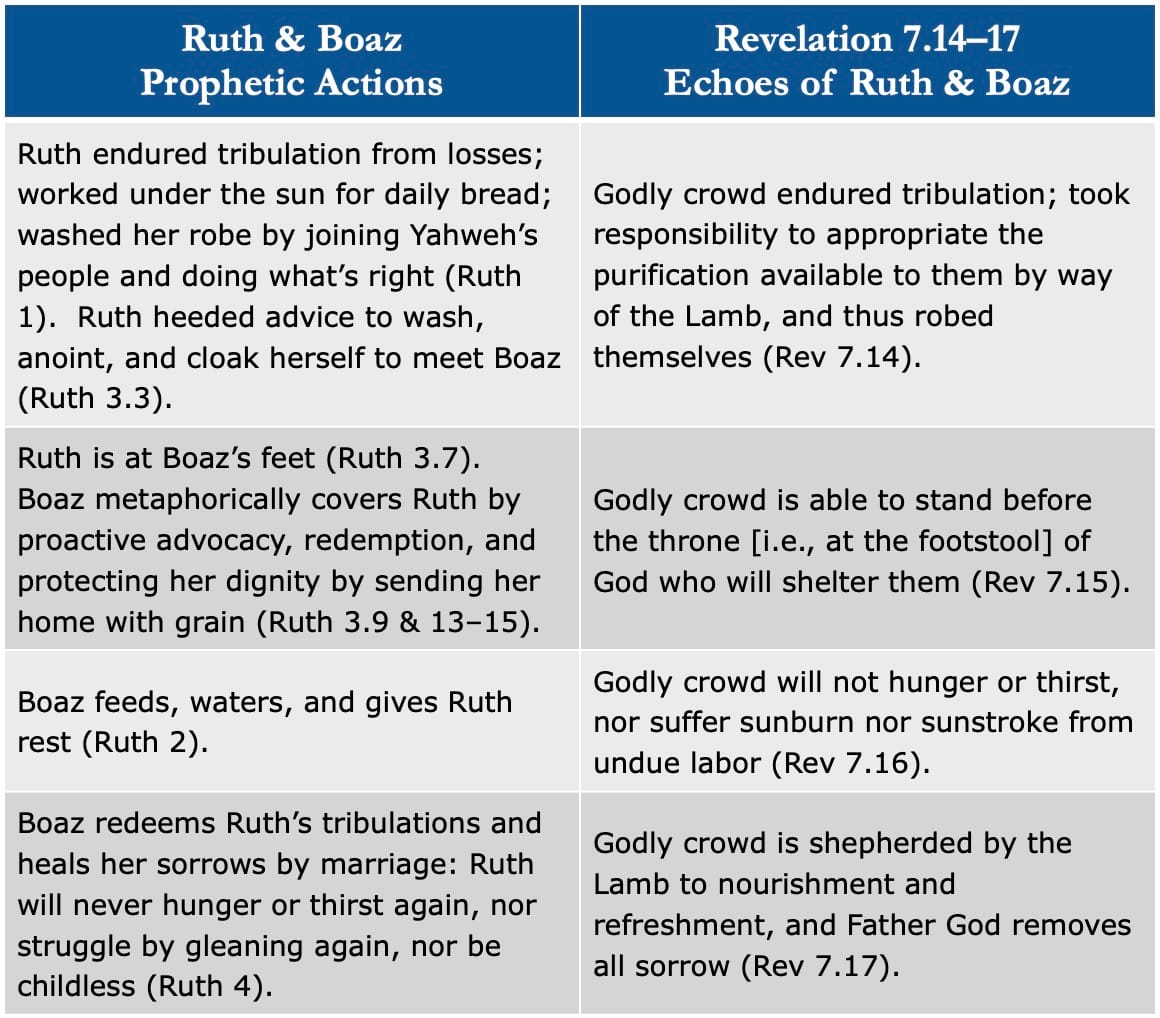
By their lives of faithfulness, Ruth and Boaz were unintentional prophets. Lives of faithfulness have ripple effects that join up with God's faithfulness in ways we can never imagine. It's easy to be prophetic when you're faithful.
9 Blessings
In Revelation 7.15–17 there are at least 9 blessings:
- being in God's full presence
- being sheltered
- being fed
- being watered
- being protected
- being rested
- being shepherded
- being blessed
- being soothed
If these are blessings worth wanting, then the 144,000, the countless multitudes, and Ruth and Boaz would cheer us on to:
- endure our trials and afflictions
- appropriate Christ's sanctification of our lives
- be willing to humbly be at his feet
- rejoice in the privilege of being in his presence
Let us pray: Holy Spirit, help us to be more like Ruth and Boaz, more like the multitudes. Rightly order our desires, so that we dare not wait on life-after-death, but desire to do these things on this side of eternity: to endure and not give in, to wash daily in the self-sacrificial love of Christ, to sit at God's feet, and to be at God's service. Prepare us to receive your blessings and for the day you make all things right.