Sojourners/Immigrants/Resident Aliens in the Bible
Charlie asked me, "What does the Bible actually say about 'sojourners'?" Here are 18 examples of migrants in the Bible + 25 points from Yahweh's Code of Conduct, but first: 9 basic starting points before we dive in.

To jump to the quick-take, click on this link for the PDF handout:
Below I'll walk through these five sections in more detail:
- Where's this coming from and where's it going?
- 5 Foundations for Any Inter-Personal Relationships
- 4 Keys from Paul about Gentiles Migrating into God’s Family — Fulfilling Ezekiel 47.22–23
- 18 Examples of Migrants in the Bible
- 25 Insights from Yahweh’s Code of Conduct for Sojourners Joining God’s Family in the Promised Land (ESV)
Where's this coming from and where's it going?
What's in a word?
This is a simple word and concept study of the Hebrew root ger, such as in Exodus 22.21 where the English Standard Version (ESV) renders it twice as sojourner:
"You shall not wrong a sojourner or oppress him, for you were sojourners in the land of Egypt."
—Exodus 22.21
This verse is representative of the fact that the Hebrew Bible deploys ger to refer not simply to journeying or passing through a place as an outsider or minority, but actually to residing in someone else's homeland for some period, even as the Israelites remained in Egypt for 430 years. This usage is clearly seen in the verbal form of ger that can be translated as dwell, such as in:
"The wolf shall dwell with the lamb"
—Isaiah 11.6
or
"Let me dwell in your tent forever!"
—Psalms 61.4
— forever is a long time! The Hebrew Bible tends to use words other than ger to categorize foreigners living in their own homeland or to indicate when someone is merely passing through an area.
These considerations make it clear that in most contexts, immigrant or migrant may be an acceptable translation; the verbal forms of which could be immigrate, emigrate, or migrate. Another attractive rendition is "resident alien," although this phrase does not readily lend itself to a verbal version. This study nonetheless defaults, because of its popularity in my Anglican tradition, to utilizing the ESV despite its tendency to translate ger by the archaic sojourner.
What did Yahweh want?
Exodus 22.21 is also representative of the fact that most of the nearly 200 occurrences of ger are in the normative narrative of Mosaic texts from Genesis to Deuteronomy. In other words, this word pops up most frequently when Moses is teaching Israel how Yahweh wants them to treat non-Israelite immigrants once they all live in the Promised Land. Moses paints a vision of Yahweh's kingdom on Earth contrasting starkly with the surrounding cultures of the ancient Near East where immigrants typically were afforded few if any benefits of citizenship.
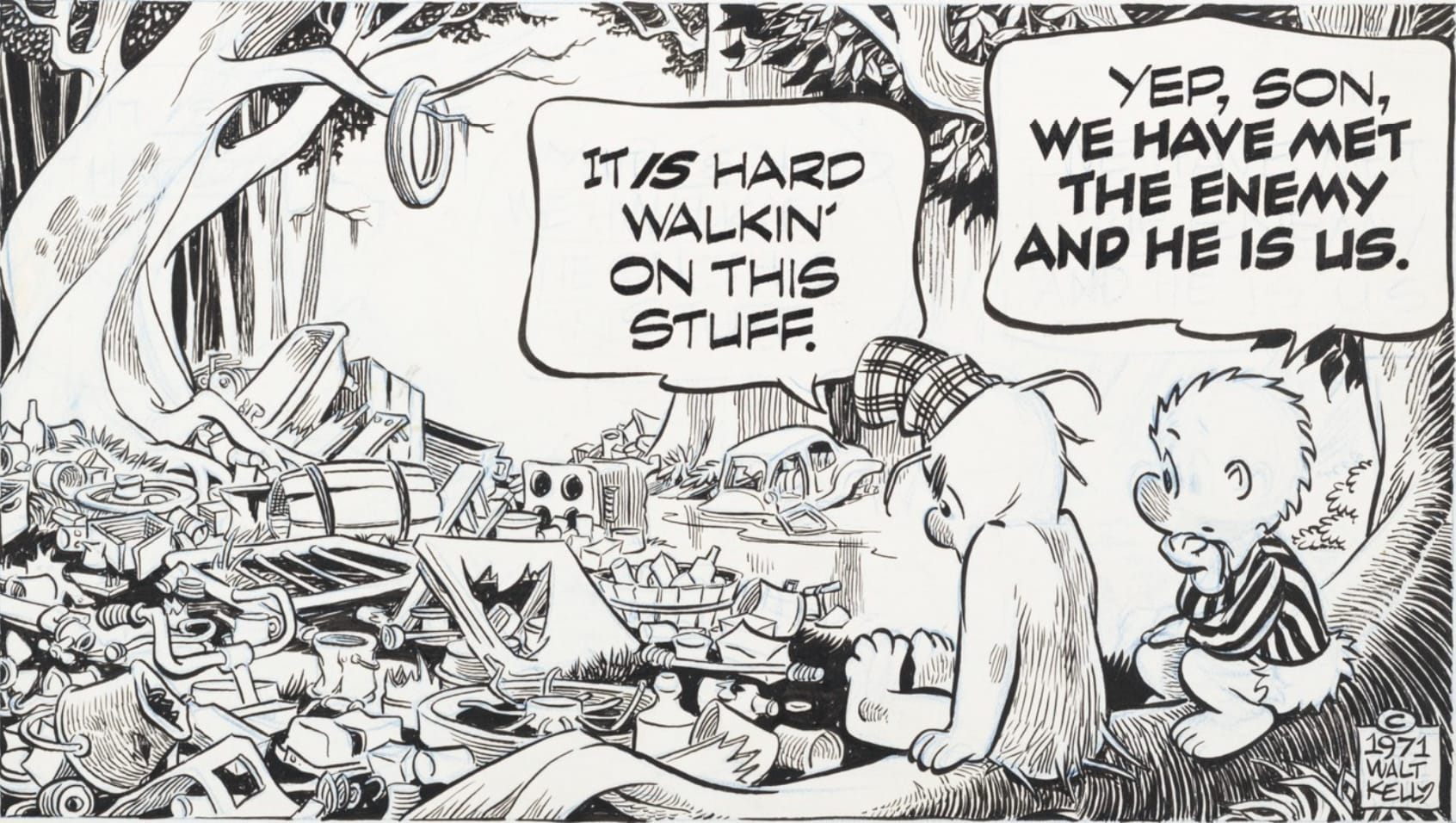
As the rest of the Bible testifies, Yahweh can take Israel out of Egypt, but taking the corrupt ethos of Egypt out of Israel is a deeper ongoing process. Likewise, Israel can kick evil enemies out of the Promised Land, but she is slow to learn the anthropological truth that, in the words of Walt Kelly, "We have met the enemy and he is us." Israel will get itself exiled from the Promised Land in part for its un-Godly treatment of non-Israelites.
Is this getting political?
My agenda in this piece is biblical exposition and biblical theology, not theological politics, let alone polemical political punditry. I am not setting out to affirm or threaten anyone's political convictions about immigration — chances are your favorite professional podcaster or blogger has tons more influence on you than I ever will. Nor am I attempting to lobby you on how to vote — you've probably decided that months ago.
How am I implicated?
That said, I am motivated to see us ask the sorts of questions we should be asking whenever we are confronted with biblical revelation: How am I implicated? What are the implications for me; for my family; for my church family; for the tribes I belong to? Will I pass the test to sacrifice my own understanding in favor of God's agenda, or will I be tempted to grasp forbidden fruit and hide from God?
Such honest self-examination may lead to no obviously political implications or applications. Or, it may lead directly to a host of political, social, and economic shifts. In any case, the Holy Spirit is ready to impart God's living Word to open hearts through his written Word.
5 Foundations for Any Inter-Personal Relationships
The biblical stories and laws about immigrants necessarily involve moral scenarios and invite ethical questions. These are inter-personal matters. Therefore it is helpful before diving into the word and concept study to briefly rehearse some biblical foundations for our human relationships.
- All persons are made in the image of God (Genesis 1.26–27)
- Golden Rule: Do unto others as you would have them do unto you (Matthew 7.12)
- The Great Commandments: Love God & neighbors (Matthew 22.37-40)
- Fruit of the Spirit (Galatians 5.22–23)
- Christian love is self-sacrificial (Philippians 2.1–8)
4 Keys from Paul about Gentiles Migrating into God’s Family — Fulfilling Ezekiel 47.22–23
When considering biblical injunctions between ethnic groups, it's particularly helpful for non-Jews (gentiles) to recall their place in God's economy. For the past 1,890 years, the vast majority of people following Yeshua (Jesus) as their Messiah have been gentile. Thus it has been easy for gentiles to forget that during the days of the New Testament and through the early part of the 100s, they were minorities and immigrants in the church.
- Gentiles are grafted into the ‘Olive Tree’ of God’s Chosen People (Romans 11.17–24)
- Gentiles & Jews are united in one Messianic congregation (Galatians 3.28)
- Gentiles have citizenship with Messianic Jews (Ephesians 2.19)
- Our primary citizenship is in Heaven (Philippians 3.20)
18 Examples of Migrants in the Bible
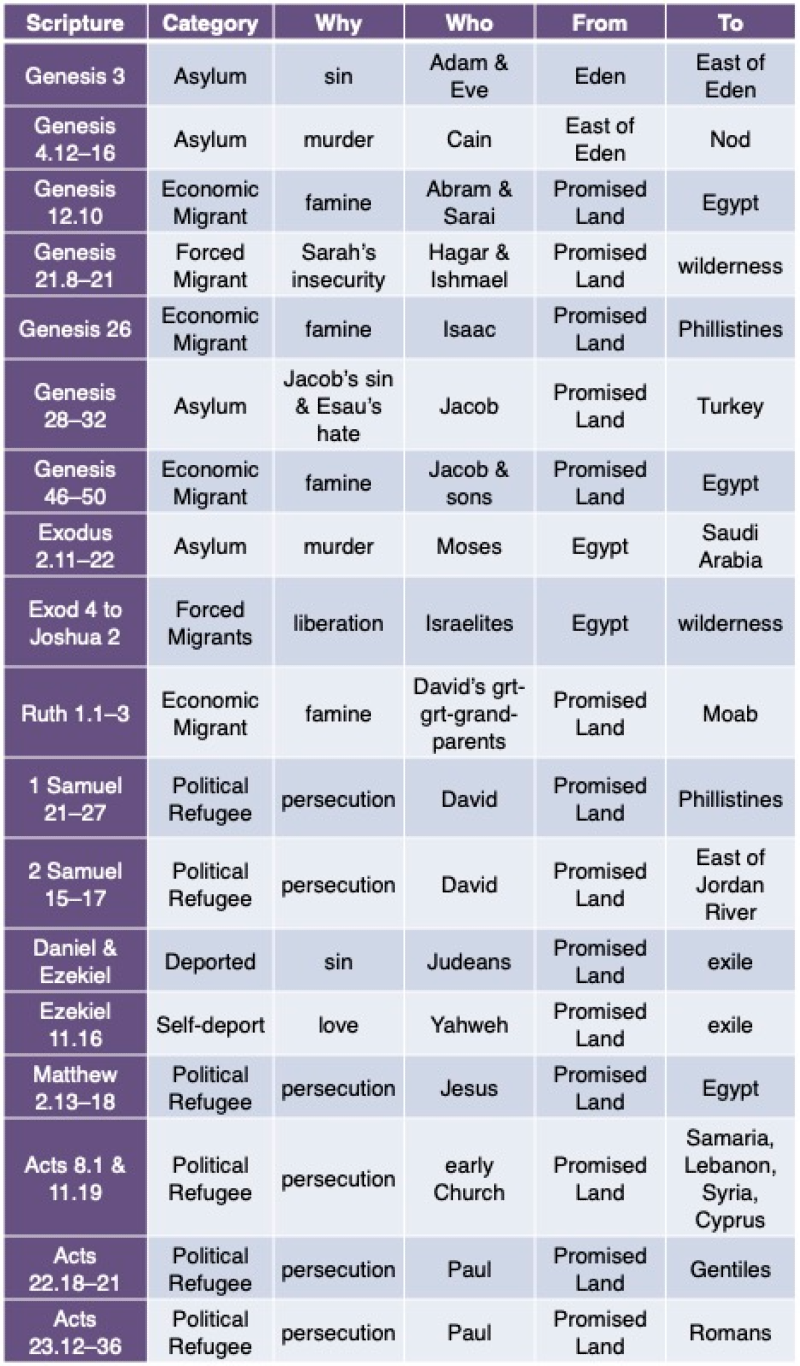
The following table is a concept study of migrants in the Bible, distilling 18 examples off the top of my head. Obviously, human migrancy has been a common experience of people in the biblical documents. In fact, one could say that migration has played a pivotal role in the lives of God's people.
Adam and Eve's having to seek asylum outside of Eden is the human condition writ small. All three of Israel's patriarchs were economic migrants due to food insecurity. David as prince and then as king survived political persecution only by becoming a refugee.
Ezekiel 11.16 may be my second most favorite verse in Bible. I translate this verse's end as:
"I am a sufficient sanctuary for them in the lands there where they have gone.”
—Ezekiel 11.16
This is Yahweh’s merciful response to Israel’s distancing God from his sanctuary (Ezekiel 8.6). In contrast, Yahweh will remove himself from Jerusalem, be their sanctuary while they are in exile, graciously prophesy their restoration (Ezekiel 11.17), and rest his presence outside Jerusalem on the Mount of Olives (Ezekiel 11.23) as a prophetic sign of what Jesus would do.
In Acts of the Apostles we see the Triune God redeeming political persecution. In the beginning, Jesus commissions the apostles to spread his good news to the ends of the Earth (Acts 1.8). By the end, Jesus's political refugees have indeed spread the gospel to Samaria, Lebanon, Syria, throughout Mediterranean islands and cities, and to Rome.
25 Insights from Yahweh’s Code of Conduct for Sojourners Joining God’s Family in the Promised Land (ESV)
Yahweh's Code of Conduct paves the way for Israel and her immigrants to love Yahweh and to love one another in the Promised Land. Yahweh has revealed every opportunity for them to thrive in their new shared homeland. To the extent that they do so, they will be a beacon of wisdom that draws other nations to love Yahweh.
For each enumerated highlight, there will be one Bible verse, sometimes followed by citations for similar verses, and sometimes followed by my brief commentary.
1 Sojourners must observe the feast of unleavened bread
Exodus 12.19 For seven days no leaven is to be found in your houses. If anyone eats what is leavened, that person will be cut off from the congregation of Israel, whether he is a sojourner or a native of the land.
Yahweh prescribed non-Hebrews to observe certain Hebrew annual traditions, which would help keep Israel accountable to their devotion to Yahweh and their rituals of communal identity.
2 If sojourners want to celebrate Passover, they must be circumcised
Exodus 12.48 If a stranger shall sojourn with you and would keep the Passover to the LORD, let all his males be circumcised. Then he may come near and keep it; he shall be as a native of the land. But no uncircumcised person shall eat of it.
Numbers 9.14, 2 Chronicles 30.25
Passover observance is optional for non-Hebrews. But because Passover is unique to the Hebrews and their identity, any male non-Hebrews wanting to participate must undergo circumcision.
3 There’s one code of ethics for God’s family
Exodus 12.49 There shall be one law for the native and for the stranger who sojourns among you.”
Leviticus 18.26, Leviticus 24.22, Numbers 15.14–30, Numbers 19.10
Yahweh unified people in living by his code of conduct, rather than being divided by the chaos of overlapping jurisprudence.
4 Sojourners benefit from Sabbath rest
Exodus 20.10 but the seventh day is a Sabbath to the LORD your God. On it you shall not do any work, you, or your son, or your daughter, your male servant, or your female servant, or your livestock, or the sojourner who is within your gates.
Exodus 23.12, Leviticus 16.29, Leviticus 25.6, Deuteronomy 5.14
Yahweh's code of conduct, in contrast to the laws of other ancient Near East people groups, provided real benefits for immigrants.
5 Sojourners benefit from the Golden Rule
Exodus 22.21 “You shall not wrong a sojourner or oppress him, for you were sojourners in the land of Egypt.
Exodus 23.9, Leviticus 19.33–34
6 Sojourners cannot consume blood
Leviticus 17.8–15
7 Sojourners benefit from gleaning
Leviticus 19.10 And you shall not strip your vineyard bare, neither shall you gather the fallen grapes of your vineyard. You shall leave them for the poor and for the sojourner: I am the LORD your God.
Leviticus 23.22, Deuteronomy 24.19–21
8 No sacrificing children
Leviticus 20.2 “Say to the people of Israel, Any one of the people of Israel or of the strangers who sojourn in Israel who gives any of his children to Molech shall surely be put to death. The people of the land shall stone him with stones.
9 Burnt offerings
Leviticus 22.18 “Speak to Aaron and his sons and all the people of Israel and say to them, When any one of the house of Israel or of the sojourners in Israel presents a burnt offering as his offering, for any of their vows or freewill offerings that they offer to the LORD,
10 No blaspheming
Leviticus 24.16 Whoever blasphemes the name of the LORD shall surely be put to death. All the congregation shall stone him. The sojourner as well as the native, when he blasphemes the Name, shall be put to death.
11 Everyone is a sojourner
Leviticus 25.23 “The land shall not be sold in perpetuity, for the land is mine. For you are strangers and sojourners with me.
Psalms 119.19, 1 Chronicles 29.15
This is an amazing verse. Yahweh is warning his especially chosen people — whom he lavishes with prodigal abundance as a sign of his self-sacrificial love despite their stiff-necked, hard-heartedness — to heed the fact that even they are his guests who are mere resident aliens in the Promised Land.
12 Israelites may enslave sojourners
Leviticus 25.45 You may also buy from among the strangers who sojourn with you and their clans that are with you, who have been born in your land, and they may be your property.
Yahweh's social safety net for impoverished immigrants who cannot make a livelihood for themselves or be supported by their immigrant community in the Promised Land is that they may indenture themselves to Israelites.
13 Sojourners may enslave Israelites as indentured servants until Jubilee
Leviticus 25.47 “If a stranger or sojourner with you becomes rich, and your brother beside him becomes poor and sells himself to the stranger or sojourner with you or to a member of the stranger’s clan,
Likewise, impoverished Israelites whom no fellow Israelite hires for up to 6 years, may indenture themselves to immigrants for up to 49 years until the next Jubilee year.
14 Sojourners benefit from cities of refuge
Numbers 35.15 These six cities shall be for refuge for the people of Israel, and for the stranger and for the sojourner among them, that anyone who kills any person without intent may flee there.
Joshua 20.9
15 Sojourners benefit from equal justice
Deuteronomy 1.16 And I charged your judges at that time, ‘Hear the cases between your brothers, and judge righteously between a man and his brother or the alien who is with him.
Deuteronomy 10.18, Deuteronomy 24.17 & 27.19, Jeremiah 7.6 & 22.3, Ezekiel 14.7, Zechariah 7.10
Yahweh's justice is blind. The immigrant has equal access to due process. (n.b. This is one passage where ESV renders ger as alien.)
16 Sojourners benefit from equal love
Deuteronomy 10.19 Love the sojourner, therefore, for you were sojourners in the land of Egypt.
Deuteronomy 24.14
17 Sojourners may eat animals that died naturally
Deuteronomy 14.21 “You shall not eat anything that has died naturally. You may give it to the sojourner who is within your towns, that he may eat it, or you may sell it to a foreigner. For you are a people holy to the LORD your God. “You shall not boil a young goat in its mother’s milk.
18 Sojourners benefit from Thanksgiving meal every 3 years
Deuteronomy 14.29 And the Levite, because he has no portion or inheritance with you, and the sojourner, the fatherless, and the widow, who are within your towns, shall come and eat and be filled, that the LORD your God may bless you in all the work of your hands that you do.
Deuteronomy 26.12–13
Yahweh prescribed that in every 3rd year, every village would gather its tithes and redistribute them locally for their needy residents. This triennial provision of sharing the blessings of local abundance could be life-changing. Immigrants could be kept out of poverty. Perhaps the enslaved could buy their freedom. The income of leaders in the central hubs of Israel would be moderated.
19 Observe Feast of Weeks
Deuteronomy 16.11 And you shall rejoice before the LORD your God, you and your son and your daughter, your male servant and your female servant, the Levite who is within your towns, the sojourner, the fatherless, and the widow who are among you, at the place that the LORD your God will choose, to make his name dwell there.
20 Observe Feast of Booths
Deuteronomy 16.14 You shall rejoice in your feast, you and your son and your daughter, your male servant and your female servant, the Levite, the sojourner, the fatherless, and the widow who are within your towns.
21 Praise Yahweh for the Promised Land
Deuteronomy 26.11 And you shall rejoice in all the good that the LORD your God has given to you and to your house, you, and the Levite, and the sojourner who is among you.
22 Sojourners will rule if Israel abandons God
Deuteronomy 28.43 The sojourner who is among you shall rise higher and higher above you, and you shall come down lower and lower.
Isaiah 5.17
Yahweh puts Israelites on notice that if they abandon him, their immigrants will rule over them. If the positive orders to love and serve justice to immigrants left Israel unmoved to treat immigrants well, the stick of this negative prospect should have proved sufficient motivation to do so.
23 Sojourners participate in covenant renewal
Deuteronomy 29.11 your little ones, your wives, and the sojourner who is in your camp, from the one who chops your wood to the one who draws your water,
Deuteronomy 31.12, Joshua 8.33–35, Isaiah 14.1
24 Israel is judged for harming sojourners
Ezekiel 22.7 Father and mother are treated with contempt in you; the sojourner suffers extortion in your midst; the fatherless and the widow are wronged in you.
Ezekiel 22.29, Malachi 3.5, Psalm 94.6
Yahweh must indict and prosecute Israel for their failure to heed his code of conduct in the Promised Land. Now they will return to being sojourners themselves in a foreign pagan land.
25 By 2nd generation sojourners get equal status
Ezekiel 47.22 You shall allot it as an inheritance for yourselves and for the sojourners who reside among you and have had children among you. They shall be to you as native-born children of Israel. With you they shall be allotted an inheritance among the tribes of Israel.
Yahweh gives Ezekiel a vision of his re-created Promised Land where immigrants will be granted full citizenship with the children of Abraham and Sarah. All will share in the abundance of God's provision on equal footing. All will be sojourners together with God.